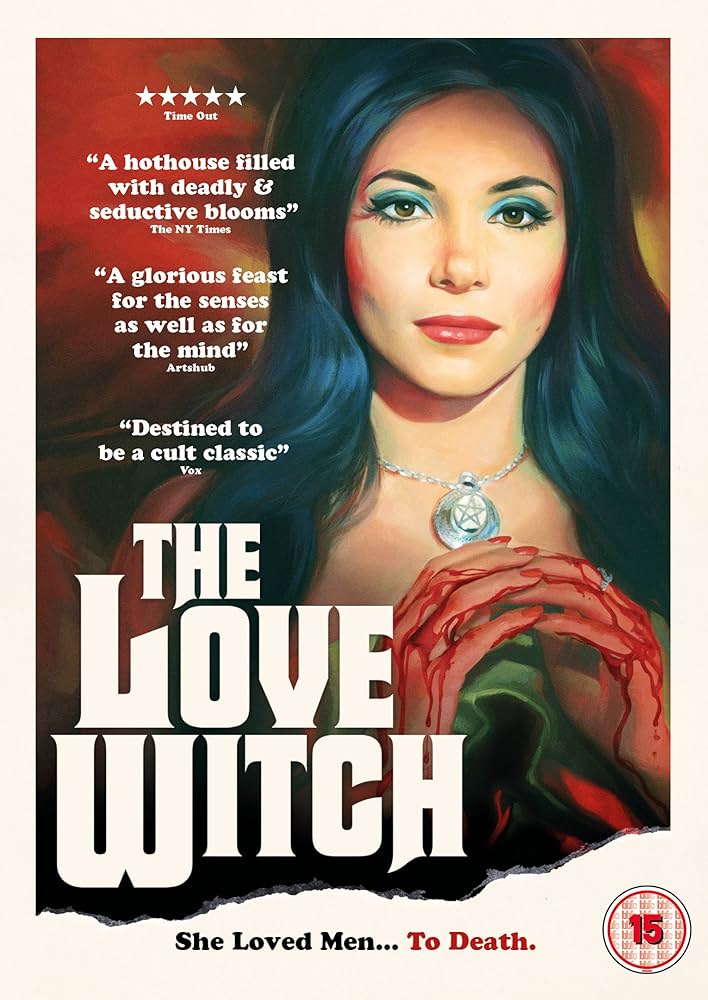
I first stumbled upon The Love Witch at the Milwaukee Film Festival—drawn in by nothing more than its title and a single image—and I knew. I knew I was about to witness something special, something that would burrow its way into my imagination. And I was so right.
Anna Biller’s The Love Witch is camp in the most delicious sense of the word. It’s dazzling, deliberate, and dripping in witchy Technicolor glamour. Every frame is carefully composed, like a Valentine from another era, a kaleidoscope of lush color palettes, Victorian-meets-1960s costuming, and sets so ornate you want to crawl inside them. Biller didn’t just make a film; she conjured one from pure magic.
I love how it’s shot on 35mm—it gives the whole film a grit and aliveness that digital just can’t replicate. Anything too smooth makes me feel like I’m watching a soap opera, but here the texture practically breathes off the screen. The opening scene of Elaine driving is a perfect example: Biller used the same old-school Hollywood method Hitchcock and others relied on, projecting the road behind her rather than filming on location. The result is dreamlike and just a little unreal, precisely like the rest of the movie.
At the center of it all is Elaine, played with unforgettable poise by Samantha Robinson. Elaine is more than a witch; she’s a vision. A living pin-up, a tragic romantic, and a gorgeous warning all at once. She’s the kind of character you can’t look away from, even when you know her brand of love and obsession can only end in destruction. Her makeup, her outfits, her longing glances—all of it becomes spellbinding, an intoxicating mix of allure and menace.
What sets The Love Witch apart from other witch films is how it skips the usual “becoming.” In The Craft, Suspiria, and The Witch—so many of my favorite witch films—we watch women gain their power, often through trauma, repression, or rebellion. But Elaine? She already has her power. The film asks us to immediately accept her as a witch, no questions, no origin story. That makes the whole thing lighter, dreamier, more like a fairytale. And while she isn’t really a “good witch,” her darkness doesn’t come from malice or rage. Elaine is chasing something that isn’t real: the perfect, storybook romance. That doomed search makes her sympathetic even as she leaves heartbreak and ruin in her wake.
Yes, this is a film where vibes take precedence over plot. But when the vibes are this juicy, why would you ever complain? The Love Witch feels like opening a perfume bottle: richly styled, heady, and potent, best savored in small, luxurious doses. It’s a world you want to get lost in, even if you never quite trust it.
What’s most fascinating is how this spell has lingered. The Love Witch has rightfully gained cult status in the years since its release. At almost every horror convention or witchy fair I attend, I see Elaine’s face peering out from art prints, enamel pins, and altar-worthy merch. She has become an icon not only of witch cinema but of aesthetic empowerment, a figure who embodies beauty and danger, fantasy and critique.
Ultimately, The Love Witch isn’t just a movie; it’s a mirror. It reflects our cultural obsession with beauty, love, and power back at us in shimmering, sometimes brutal ways. If you’re drawn to femme horror, arthouse sleaze, or anything soaked in glamour and longing, consider this essential viewing. Anna Biller cast her spell almost a decade ago, and it’s still working.
 Horror She Watched
Leave a comment