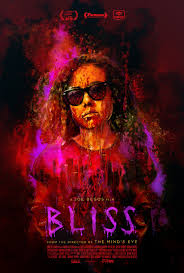
This is an all-time favorite. I was lucky enough to see Bliss at its premiere at Beyond Fest in Los Angeles, projected on film as intended. This was shot on 16mm, which gives it that grainy, tactile quality that makes the whole experience feel raw and alive. Paired with another Joe Begos feature, it completely blew me away. This movie is a neon-soaked, nightmare version of LA that feels both meticulously designed and thoroughly lived in. It’s a city I recognize, just with the grit turned up. A perfect backdrop for a story about art, addiction, and vampirism.
The film follows Dezzy, a starving artist clawing her way through the underbelly of Los Angeles. She’s stuck, both creatively and emotionally, and numbs herself with drugs, parties, and chaos. When she tries the newest drug hawked on her by her dealer, played by Graham Skipper, an indie horror favorite, she’s thrust into a cycle of blackouts, bursts of artistic inspiration, and a descent into vampirism. It’s as much about losing yourself to the process as it is about losing yourself to bloodlust. And yes, there’s absolutely no way Dezzy could afford that loft in real life LA. But as a set it’s gorgeous, perfectly capturing the chaotic, lived in energy of an artist on the brink.
What I love most is the painting itself, the one Dezzy creates during the entirety of the film. It progresses, almost like another character in the film. At first it feels chaotic, abstract, and bloody. The longer Dezzy lives in her vampirism, the more bodies appear at the bottom, multiplying as time passes. It’s perhaps a silent record of her kills. Some we witness, others we only sense, but the canvas holds them all. By the end, it’s not just a painting. It’s her transcendence, the moment she fully merges creation with destruction. Personally, it reminded me of a painting I once saw in a local gallery called Prayer is Better than Sleep. A sea of red that carried the same raw, unsettling intensity. Seeing Dezzy finish her piece gave me a sense of familiarity in an otherwise very unfamiliar world.
Dora Madison, who plays Dezzy, nails the performance. She does “unhinged” so convincingly that you never doubt her. Dezzy begins the film loud and abrasive, normally not the kind of character I would gravitate toward, but she’s so mesmerizing you can’t look away. One of my favorite recurring images is her behind the wheel. Begos cuts back to shots of her driving in different states of unraveling. At first it’s daylight, then gradually darker each time, a quiet marker of how much time has passed. Time that we, like Dezzy, begin to lose all sense of as the story unfolds. Madison throws herself into the role, drenched in sweat and neon light, and it’s hypnotic to watch. The other artists, partygoers, predators orbiting her world aren’t fully fleshed out, but they don’t need to be. They’re there to feed into her spiral, reflections of the scene that both fuels and destroys her. Jesse Merlin, who I have met in real life and is the sweetest puppy of a person, is jarringly smooth and terrifying. That contrast makes his performance all the more effective. I also have to call out Rhys Wakefield who I’ve been obsessed with him since The Purge. He walks the line between effortlessly cool and deeply unsettling. One of the standout sequences comes after Dezzy finally leans into her vampire fate. Begos straps the camera directly to her, locking our gaze as she staggers forward, pulling us inside her transformation. It’s spectacularly disorienting. The dancing scene with Courtney is equal parts hypnotic and horrifying. The music makes it even more unnerving. You feel the tension building under the surface, threatening to rupture at any moment.
Visually, Bliss is stunning. Begos leans into heavy neon, distorted sound design, and gritty, hallucinatory editing that makes you feel like you’re tripping alongside Dezzy. It’s immersive in the best way. You can practically taste the sweat, booze, and desperation. The bar scene is a perfect example, lit in his signature palette of neon green, red, and blue. I love that consistency across his work, the way he exaggerates color to turn every space into something both garish and hypnotic. The score is just as vital. When Dezzy first throws herself into the painting after her drug fueled night, a heavy rock track kicks in. It feels like pure, unbridled creativity bursting through the screen. The music doesn’t just accompany her, it pushes her forward, amplifying the mania of the moment until you’re right there with her. It’s raw and ugly, but also strangely beautiful, which is exactly what a movie about making art in hell should be.
Bliss isn’t just a vampire film, or a drug trip film, or an art film. It’s all of those at once, tangled together into something wild and unforgettable. It captures what it feels like to lose yourself in creation, whether to inspiration or to destruction, and it refuses to let go until the final, blood-soaked frame.
 Horror She Watched
Leave a comment