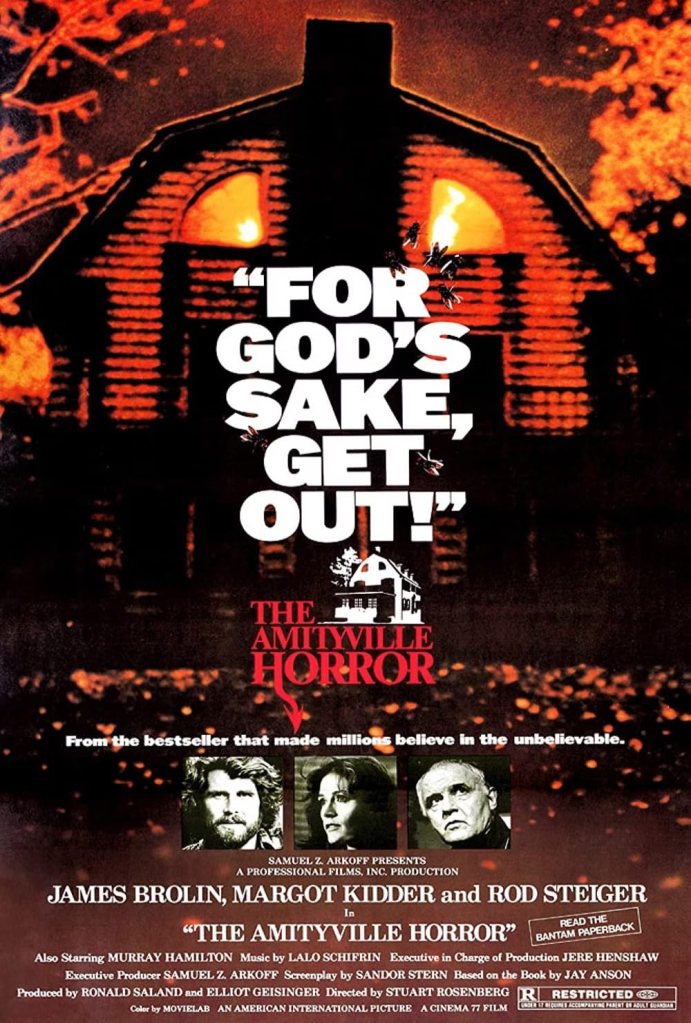
The Amityville Horror remains as effective today as it was upon its release, and for many reasons. It is the perfect fall movie, steeped in New England gloom and dread, the kind of horror that practically oozes crisp air, dead leaves, and the weight of something unspeakable lurking behind a closed door.
The 1979 film was the first adaptation of Jay Anson’s book, a massive bestseller marketed as a “true story.” People believed it was real, at least for a while, and that cultural moment gave the film an extra charge. It has since spawned countless sequels, prequels, and reimaginings, but none of them have ever quite captured the same feeling as the original. Maybe that’s because nothing can compare to seeing it so close to the book’s release, when the story still felt like living folklore.
The acting elevates the film. Margot Kidder is unforgettable here; her screams are the stuff of horror legend. There’s a moment where she bolts upright in bed, shrieking that she was shot in the head, and it makes your blood run cold even now. Another standout scene comes early, when the priest arrives at the house and finds the family outside. The flies begin to buzz, the door slams shut, and then that booming voice says, “Get out.” When the door creaks open again, the timing and execution are flawless. It’s still chilling decades later.
What makes Amityville so haunting is its attention to atmosphere. The sickly yellow that runs through the film, from the wallpaper to the leaves outside, evokes bile and jaundice, giving everything a feeling of rot. The score by Lalo Schifrin should be mentioned in the same breath as the best in horror history: eerie, beautiful, and hair-raising all at once. It sets the mood before a single scare unfolds.
The house isn’t just a backdrop; it’s a character. The camera studies it from every angle: looming in the rain, glowing with menace at night, brooding in daylight. We don’t just watch the house; we feel its moods and its anger. The horror doesn’t creep in slowly; it’s there almost immediately, a presence felt in the walls and in the air.
One of the most remarkable things about this film is that it doesn’t rely on gore. The horror is psychological, suggestive, built from sound, setting, and performance. The film knows the human imagination can conjure worse than any special effect, and it trusts us to fill in the blanks.
And yes, the dog lives.
The film also has a grit to it that feels inseparable from the 1970s. It’s a movie that, in my opinion, plays best on VHS. The grain, the wear, the fuzziness of the tape all add to the sensation that you’ve been pulled back in time to a different era of horror, when the line between fiction and reality felt much thinner.
Almost fifty years later, The Amityville Horror remains iconic because it does everything right: performances that burn into your memory, a house that feels alive, a score that unsettles you to your core, and an atmosphere that turns autumn into a season of terror. It is not the kind of film that will traumatize you with gore or relentless violence. Instead, it lingers in suggestion and mood. That is what makes it, strangely, a kind of cozy fall horror. The New England setting, the moody color palette, and the absence of cheap jump scares all combine to create an unsettling film without being overwhelming. It is the perfect haunted house story to watch on a chilly night, when you want the season to wrap around you with just enough dread.
 Horror She Watched
Leave a comment