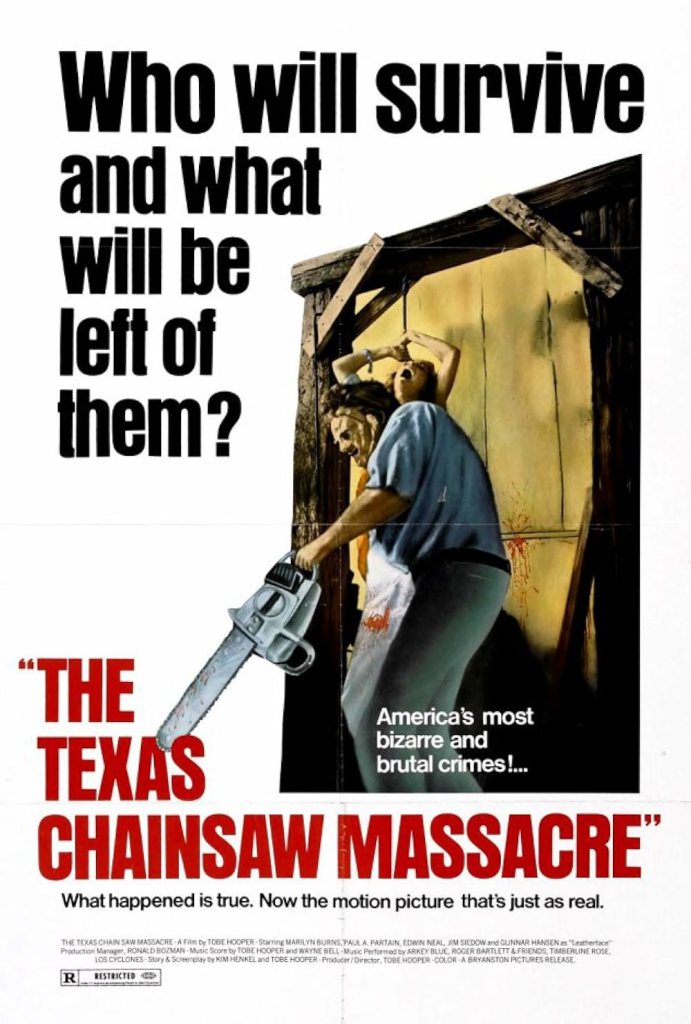
Few films make you feel as physically uncomfortable as The Texas Chain Saw Massacre. The sweat, the heat, the buzzing flies, the stench you can practically smell through the screen. It is suffocating before the real horror even begins, and before Leatherface ever appears, the film already has its claws in you. The opening credits alone make my stomach drop: flashes of corpses, a low monotone voice, and that piercing, scratching sound that could drive you insane if it went on a second longer. Texas Chain Saw remains one of the only horror films that feels less like fiction and more like someone smuggling real violence onto film.
I don’t remember the first time I saw this one, but I will never forget the times I got to see it on the big screen. During the pandemic, I caught it at a drive-in, and it was magical. A film that already feels raw and outlaw suddenly felt like secret cinema again, projected under the stars while everyone sat in their cars. Years later, I saw the 50th anniversary screening at Beyond Fest in Los Angeles, where I got to meet my favorite character, the Hitchhiker. Both screenings were incredible for different reasons, and together they have become my new memories of Texas Chain Saw.
The Beyond Fest screening also came with something extra. Eli Roth praised the film before and after during a Q&A with almost all remaining members of the cast. He called it one of the most important horror films ever made. Members of the cast spoke about their experiences afterward, and you could feel how much reverence the movie still commands. Roth even circled back to underline how singular Texas Chain Saw is, almost as if words could not quite measure it. That is what struck me most, that even half a century later, the film inspires awe and intimidation in equal measure.
This movie is gritty in a way that few others are. It looks dirty, and it makes you feel dirty: the van, the sweat, the collapsing interiors of that farmhouse, the Hitchhiker smeared in blood. Even the old furniture feels infected. The film is also mean. There is little mercy in it, aside from our final girl, but even she is dragged through hell first. People talk about The Texas Chain Saw Massacre like it is the goriest film of all time, but there is actually very little blood. It is not about gore. It is about peril and fear.
The setting is what makes it terrifying. The creepy, dilapidated farmhouse and the endless stretch of nowhere around it are unnerving on their own. The family is menacing not just because of the makeup or the insanity they radiate, but because it never plays over the top. You believe it. By the time you are at that dinner table with Sally, you don’t feel like an audience member anymore. You are trapped there, too.
And that is why The Texas Chain Saw Massacre still cuts as deep today as it did fifty years ago. It is feral, raw, and dangerous, a film that refuses to dull with time. Sitting in a theater surrounded by fans, watching Leatherface whirl his chainsaw and Sally scream, felt less like revisiting an old film and more like bearing witness to something alive. This movie still has teeth.
 Horror She Watched
Leave a comment